Showing posts with label stitch patterns. Show all posts

Thursday, October 16, 2014

be fancy :: eyelet stitches

Welcome back to FancyStitchLandia! Our last stop was Block Stitch & Friends, where we learned that the most basic combinations of knit and purl can yield beautifully-textured results.

You can knit and purl, so I know you’ve got those patterns down. Now… can you increase and decrease? Some yarn-overs and K2togs are all you need to get yourself started with sweet little eyelet patterns that can make your knitting look way fancier, way more feminine, and/or just way more interesting, depending on how you work them. [Don’t know how to work a yarn-over (YO) yet? Check out this simple how-to and then come right back!]

There are more eyelet patterns than you could possibly imagine. Adding just a few eyelets to a project can provide really useful features besides visual interest. You can use eyelets to make buttonholes, vents, or a track for a belt or ribbon. Eyelets are the foundation upon which the timeless dishcloth pattern is built, though I cannot endorse frittering one’s knitting time away on a project that encourages housework. Lace (also known as openwork) is just a pattern that features lots and lots of eyelets. Here are some eyelet patterns to get you started:

simple eyelet pattern (multiple of 8 sts)
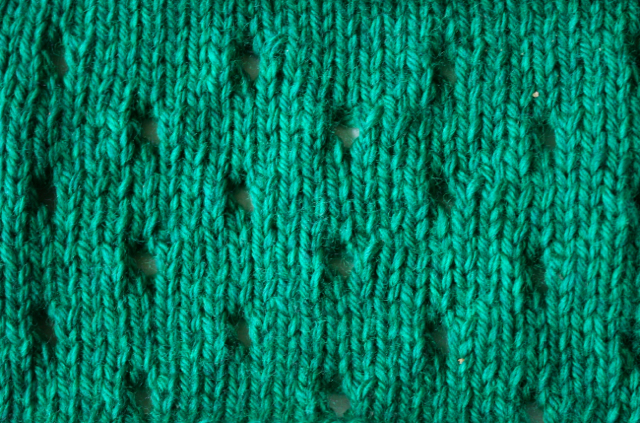
simple eyelet pattern
The most basic eyelet is formed by using a repeating pattern of YO, K2tog. Here’s a lovely simple version, courtesy of Barbara Walker's first Treasury of Knitting Patterns:

R1 (RS): Knit
R2 and all WS rows: Purl
R3: *K6, YO, K2tog. Repeat from * to end.
R5: Knit
R7: K2, *YO, K2tog, K6. Repeat from * to end.
R8: Purl.
Repeat rows 1-8.

cloverleaf eyelet pattern (multiple of 8 sts + 7)

Lucky Clover Lace Wrap / Melissa Wehrle
I love this pretty stitch pattern on ladies tops and dresses. It’s featured in the popular Lucky Clover Lace Wrap from Stitch & Bitch Nation:  

R1 and all other WS rows: Purl
R2 (RS): Knit
R4: K2, YO, Slip 1, K2tog, PSSO, YO. *K5, YO, Slip 1, K2tog, PSSO, YO. Repeat from * to end. K2.
R6: K3, YO, SSK. *K6, YO, SSK. Repeat from * to end. K2.
R8: Knit
R10: K1. *K5, YO, Slip 1, K2tog, PSSO, YO. Repeat from * to end. K6.
R12: K7. *K6, YO, SSK. Repeat from * to end.
Repeat rows 1-12.

wildflower purl
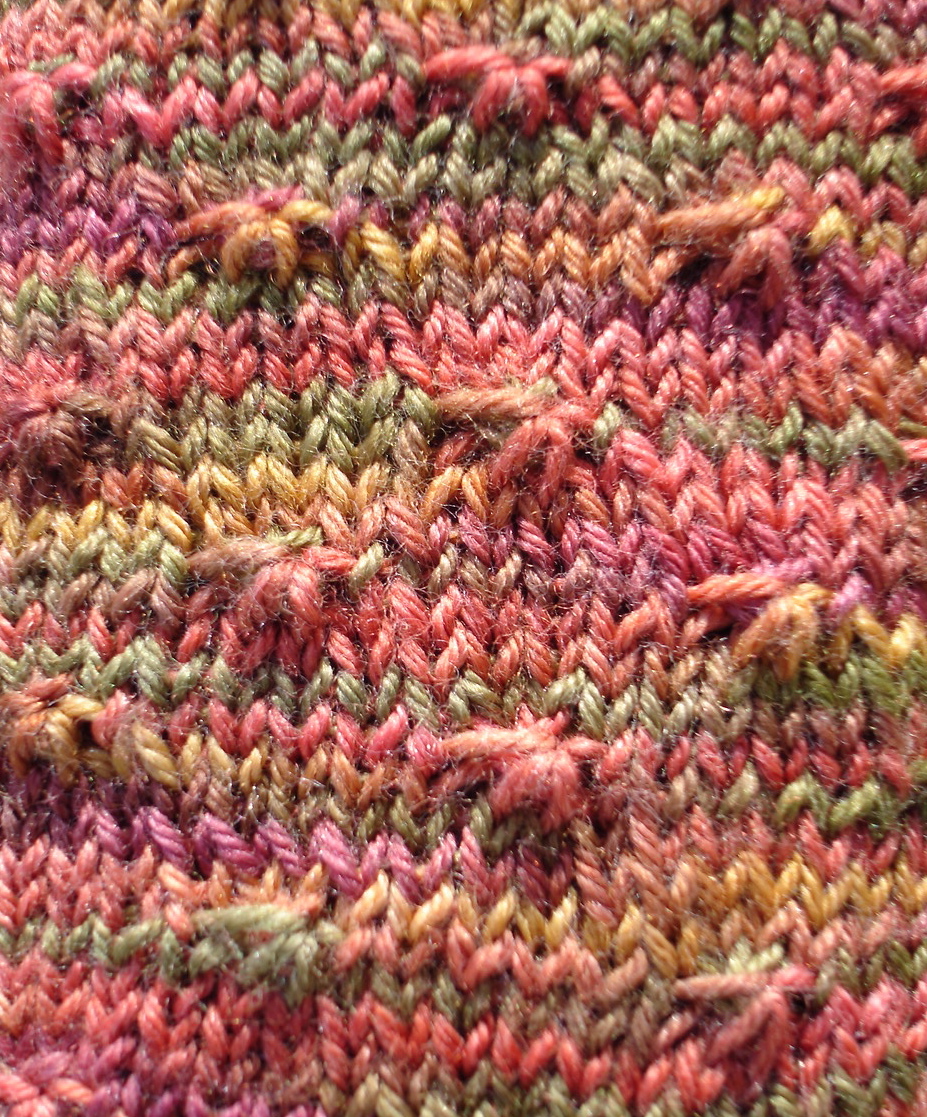
wildflower purl
This wonderful pattern is just a little bit trickier, relying on a P3tog to create the cute little wildflowers. I love how this stitch pops on variegated yarn! Instructions for working this stitch pattern in the round are included in my Wildflower Socks pattern.

quatrefoil 
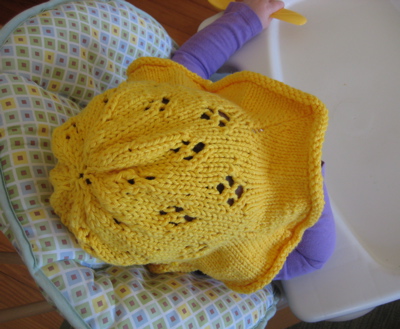
quatrefoil / sundrop hat
The quatrefoil makes a sunburst or flower design that looks great on garments and accessories alike. I used it to create both visual interest, and cooling vents, on this summer hat for babies and toddlers. Instructions for working this stitch pattern in the round are included in the Sundrop hat pattern.

Just these three variations on the simple eyelet open up a huge amount of possibility for your knitting. Even a single row of eyelet stitches at the lower hem or cuffs of a sweater add so much visual interest to a simple garment.

Check out how other designers are using eyelets in a few of these hot projects on Ravelry right now. Give them a try and let me know what you think!

clockwise from left: miette by andi satterlund | star anise by svetlana volkova | caramel frappe by monika sirna | dotted rays by stephen west


Friday, September 26, 2014

be fancy :: block stitch

Earlier this week I promised a series of posts on my favorite stitch patterns to help get you started on your journey to FancyStitchLandia. Here's the first one! Block Stitch.

Block Stitch / Blocks are 4 stitches wide by 4 stitches high
Block Stitch goes by other names, including Dice Stitch, Checkerboard and Basketweave (not to be confused with many other basketey stitches, like Basket Stitch, Basket Rib or Basket Welt). It's an incredibly simple stitch with many possible variations. Just a simple pattern that alternates blocks of knit stitches (stockinette stitch) with blocks of purl stitches (reverse stockinette). I love it because it's reversible (looks the same on both sides), and after blocking lays flat with no curling up at the ends or edges. So it's great for a scarf, and unlike many of the coolest stitch patterns, it's a bit on the manly side. 

Block Stitch is a great choice for a man's scarf, a men's or boys' pullover, or to add geometry and structure to a shawl, sweater or scarf for any gender. It also makes a great-looking bag!

Here's how to make it (directions are given for knitting flat, i.e. not in the round):

Multiple of 8 stitches / Worked over 8 rows.

R 1, 3 (RS): * K4, P4. Repeat from * to end.
R 2, 4 (WS): * P4, K4. Repeat from * to end.
R 5, 7 (RS): * P4, K4. Repeat from * to end.
R 6, 8 (WS): * K4, P4. Repeat from * to end.

The resulting fiber is a bit scrunchy (from the almost-ribbing), but just block it and press it, and it will flatten right out (unless you want the scrunchiness!). 

There are endless ways to vary this simple combination of alternating knit and purl stitches. You can make the blocks wider (such as K5, P5 or K10, P10...). You can make them taller by working the pattern over a larger number of rows. You can alternate the stockinette stitch blocks with seed stitch blocks or garter stitch blocks. Check out a few of the variations below.

Variations: 

Seed Block Stitch alternates stockinette stitch blocks with blocks of seed stitch. You could work blocks of any size, as long as they are at least 5 stitches wide. The pattern is shown here over blocks  5 stitches wide by 5 stitches high. Unfortunately this variation is not reversible, but it is really beautiful.
Seed Block Stitch / Blocks are 5 stitches wide by 5 stitches high
Multiple of 10 stitches + 5 / Worked over 10 rows 

R 1, 3 and 5 (WS): P5 *(K1, P1) twice, K1, P5. Repeat from * to end.
R 2 and 4 (RS): K5, * (K1, P1) twice, K6. Repeat from * to end.
R 6, 8 and 10 (WS): (P1, K1) twice, P1. *K5, (P1, K1) twice, P 1. Repeat from * to end.
R 7 and 9 (RS): (P1, K1) twice, P1. * P5, (P1, K1) twice, P 1. Repeat from * to end.  

Broken Block is my favorite variation on the Block Stitch. It takes the flat checkerboard and makes a wavy rib that adds depth and motion. It can be blocked and pressed to remove the ribbiness. It can be worked with just about any size blocks you like - here it is over 6-stitch blocks.

Multiple of 6 stitches / Worked over 8 rows

R1 and R3: *(K4, P2), Rep from * to end.
R5 and R7: *(P2, K4), Rep from * to end.
All even rows: Knit the K's and Purl the P's.

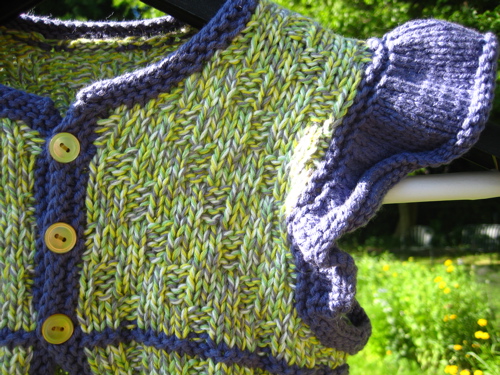
Broken Block Stitch as featured in the Cowgirl Butterfly Astronaut Vest
There are probably hundreds more variations on Block Stitch. Spend a little time fiddling around with your yarn, and you could probably invent some new ones! Have a great one to share? Please post in the comments section!

Want to learn more block stitches, not to mention thousands of other gorgeous stitch patterns? Find yourself a copy of Barbara Walker's A Treasury of Knitting Patterns (Schoolhouse Press, 1968). There are four volumes of these indispensable reference books. The Second Treasury is my absolute favorite, but I don't think I could be a knitter without any of them!


Tuesday, September 23, 2014

getting started with fancy stitch patterns

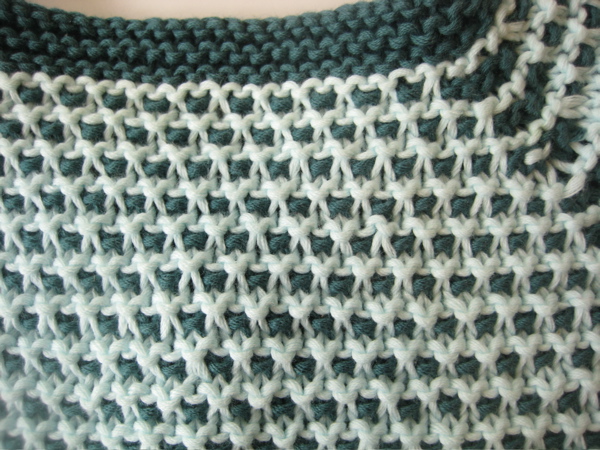
Waffle stitch in two colors (yarn: Blue Sky Alpacas Skinny Dyed cotton)
So you've made a few scarves, a great hat and even a baby sweater or two. You've got the stockinette stitch and the garter stitch down pat. Itching to try something a little more exciting?

Knitters have always used simple combinations of knit and purl stitches to add texture, beauty, and provenance to their work. Add in a yarn-over or a slipped stitch, increases and decreases, and a truly spectacular library of fascinating stitch patterns become possible.

Want to try your hand at a fancy stitch pattern? Now's the time! I'm going to lay out a few basics here, and then over the next few weeks I'll be sharing some of my favorite stitch patterns with you, with lots of photo's and step-by-step how-to's.

First, a little myth-busting:

Myth: Fancy stitch patterns are hard to knit.

Fact: You already know everything you need to! You know how to make a knit stitch, right? You can make a purl stitch? Okay, you're all set! There are literally thousands of stitch patterns based on combinations of just these two stitches.

Myth: Knitting fancy stitch patterns requires too much concentration. I won't be able to binge-watch Orange is the New Black while working on my project.

Fact: Nobody wants to interfere with your You Time, so please, don't try complicated lacework when your brain is elsewhere. But many many stitch patterns are actually quite simple. Once you've repeated K3 P1 five times, it's stuck in your brain forever, and you're free to get sucked into the viewing experience of your choice.

Myth: You can't use fancy stitch patterns for knitting top-down sweaters, and that's my favorite kind.

Fact: Uh-huh! Just about any stitch pattern can be easily adapted to the top-down technique. In fact, I wrote a whole blog post about that once with step-by-step instructions. Check it out!

If there are still any doubts in your mind about trying out some stitch patterns, please share them in the comments section so that I may obliterate them! Cast your inhibitions aside and get going. Here are a few tips:

  • Work loose stitches. I know this is easier said than done, especially for newer knitters who tend to knit more tightly. But stitch patterns often rely on twisting, slipping and otherwise manipulating your stitches after you've made them. Leave room for the fun by relaxing and knitting looser stitches.
  • Practice the stitch pattern before you start the project. The best time to do this is when you're gauge-swatching. (YOU ARE GAUGE-SWATCHING. NO ARGUMENTS!). Work a few extra rows so that you start to get it memorized. When you start your project, you'll have it right from the start.
  • Check your work against a photo. If your pattern doesn't have a clear photo of the stitch pattern, do a Google Image search to see how it's supposed to look. Sometimes the instructions aren't incredibly clear, and comparing what you've done to a good photo can help you get it right.

Ready to get started? A little added texture is a great way to show off the depth of colors in hand-dyed yarns, or to make a plain pullover suddenly elegant and far more fun to knit. Challenge yourself just a little - you'll be amazed at how much more sophisticated your knitting can become.