Monday, October 09, 2006

cloudy paddling


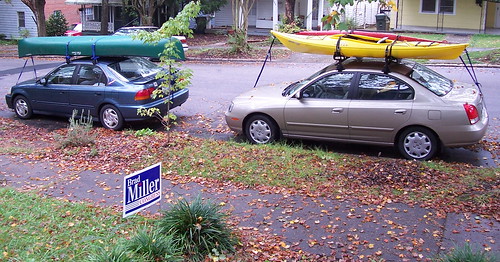
You know it's going to be a good afternoon when it starts out this way. Boats all loaded up and ready to go; PBJ's and Peterson's Field Guide to Birds of North America in your dry bag. The sky was a beautiful steel gray with low clouds like cotton wads all across the horizon.

Some old friends of HWWLLB were in town this weekend. We had long, leisurely breakfasts and late nights with lots of wine, good food and good company. On Sunday afternoon we headed out to the Eno river for two of our favorite activities: paddling and harrassing waterfowl (known to some as "bird watching"). I like cool-weather paddling because it's the only time I'll wear sandals with socks. Wool socks + sport sandals are a great combo, since wool socks stay warm even when wet, plus it makes me feel very nerdy and Germanic (especially when the socks are either black or very colorful).

There were a lot of birds to harrass. As we put in, HWWLLB and I were taking bets on how many Great Blue Herons we would see. He guessed five. I guessed eight. I think we saw at least two dozen. There was one place where we could see nine, all at one time. We also saw dozens of Great White Egrets, a species I had never seen before in North Carolina, although they do winter here (they look a lot like the white phase of the Great Blue Heron, except their feet are black and they aren't as shaggy looking).

I just hate how much we disturb them. It's hard to avoid, since they are very shy birds and don't want to be anywhere near you, so just padding past, even on the other side of the river, really bothers them. They fly off and squawk noisily, sounding like an enormous crow with a cold. Then once you're past they circle back to the fishing spot they had staked out.

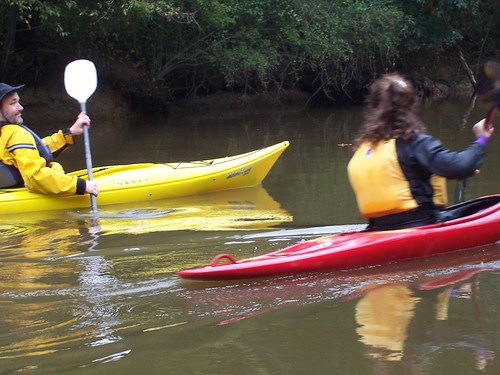
eno buddies

HWWLLB and I paddle in our great big green canoe, while our friends paddle zippy little kayaks. Together, we are known as the Birdisturbers. Watch out, waterfowl!

Friday, October 06, 2006

free pattern friday: intro to socks


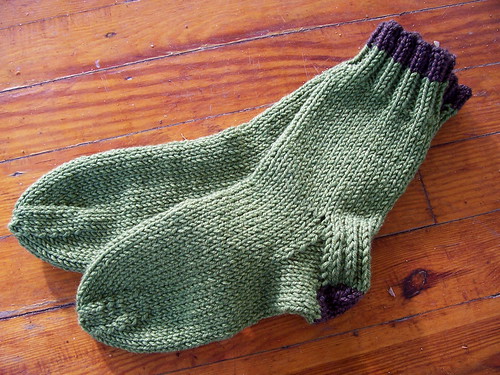
If you've never made a pair of socks before, but you've been wanting to try it, here's your chance! In honor of Socktoberfest, here is an easy pattern for a pair of simple winter socks, knitted in a large gauge so the project goes quickly. I used a superwash merino yarn that is super-soft and nicely stretchy, to make a pair of comfy, warm winter socks that you can wear with boots or just around the house.

There are about as many ways to knit socks as there are toenail polish colors, but this pattern illustrates a basic formula for sock knitting that you can use over and over again for just about any sock project. It lets you knit a basic sock in any size, and any gauge, because human feet are remarkably symmetrical (and socks are stretchy and forgiving). I deduced this formula after knitting several socks out of Anne Budd's The Knitter's Handy Book of Patterns, which was my bible when I was first learning to knit.

The basic gist of it goes like this: a 'medium' woman's foot is around 8 inches in circumference, as is her lower calf. A 'medium' man's foot is around 10 inches in circumference, as is his lower calf. I know, it sounds too good to be true, but it's just the way we evolved - for the convenience of sock knitters. So all you really have to do is knit a tube the circumference of your ankle that's stretchy and looser around the top, stick a heel in the middle, and make it long enough for your foot. Easy as pie! Really!

size: Women's medium/shoe size 7-9 US (men's medium/shoe size 9-11 US)

gauge: 4.5 stitches to the inch in st st on size US 6 needles

materials:
  • 2 (3) balls Bingo Chine (100% superwash merino, 50g/88yd) in color #515, green (main color)
  • 1 ball Bingo Chine in color #512, brown (contrast color)
  • US size 6 DPN's
  • US size 7 DPN's
  • stitch marker
  • tapestry needle
Okay, so here's the sock formula: Cast on the correct number of stitches for your gauge in order to make the circumference exactly that of your foot/lower calf - in the case of my sizing here, 8 (10) inches [so for instance, if your gauge is 6 stitches to the inch, and you want your sock to be 8 inches around, cast on 6 x 8 = 48 stitches. Easy!]. Make sure that the number of stitches you cast on is divisible by four. We will be working with half this number, and 1/4 of this number, over and over again throughout the pattern [I'll point this out using italics, over and over again until you can't take it anymore]. We'll start at the ankle, work down for the desired length, then knit a heel flap, turn the heel, pick up some stitches and do some decreasing for the heel gusset, then knit the foot of the sock, then do some more decreasing for the toe. At the end we'll graft some stitches together to make a comfy toe using the Kitchener Stitch. Ready?

Start by casting on with two size 6 needles held together - this will make your ankle really nice and elastic. Then we'll switch to regular old size 7 needles for the first part of the knitting. After a little ways, we'll change to the smaller needles. This makes the upper part of the sock a little roomier to allow for the calf.

leg & ankle
CO 36 (48) st in CC on two size 6 needles held together. Spread your stitches evenly across 3 size 7 needles (1/3 of the total number of st on each needle). PM and join, knitting in K2P2 rib.
K 4 rows in K2P2 rib, then change to MC yarn.
K 8 more rows in K2P2 rib.
Next row: Change to st st. Cont knitting in st st until sock measures 2 (3) inches long.
Next row: Change to size 6 needles. Continue knitting in st st on size 6 needles until sock measures 6 (7) inches long (or desired length).

heel flap
Next row: K9 (12), turn work. Slip first st, P17 (23). You now have half of the stitches on this needle (your stitch marker should be smack in the middle of them). Arrange the remaining 18 (24) st evenly across 2 needles (you aren't going to work with these right now, but it will be convenient to have them ready this way for later). The 18 (24) st on the single needle will form the heel flap. Turn work so that the right side is facing you [notice that half of your stitches are on the heel flap needle, and 1/4 of your stitches are on each of the two other needles].
R1: * Sl 1, K1, rep from * to end. Turn work.
R2: Sl 1, P to end. Turn work.
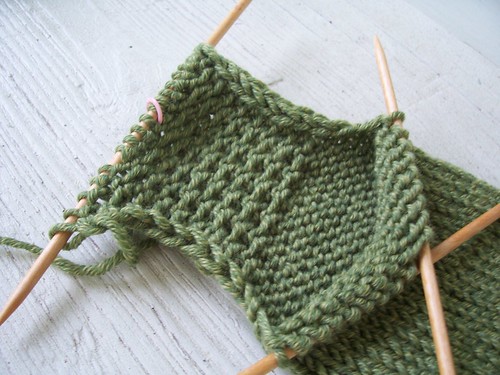
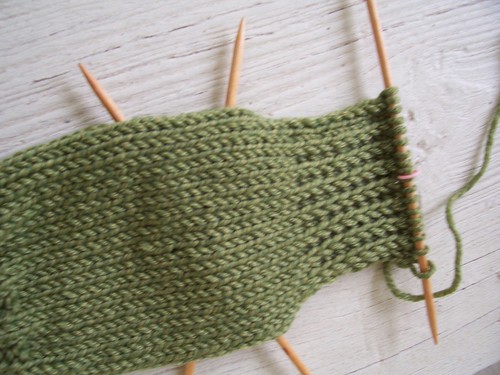
Rep these last two rows 8 more times, until you have 18 (24) heel flap rows worked altogether [whoa, 18 (24) is half of 36 (48)!]. You will have 9(12) stitches along the selvedge on each side [oh my gawd, 9 (12) is half of 18 (24)!].
heel_flap2

The way you worked the heel flap stitches (slipping every other st on the RS) makes the heel flap extra-dense and gives it some cushioning. It almost looks ribbed... but it isn't.
heel_flap1

turning the heel
The right side of the work should be facing you. Change to CC yarn.
Sl the first st, then K10 (14) st, SSK, K1, turn work.
Sl 1 st, P4 (5), P2tog, P1, turn.
Next row: Knit to 1 st before the space, SSK, K1, turn.
Next row: Purl to 1 st before the space, P2tog, P1, turn.
Repeat these last two rows until you have worked all the heel st, ending with a WS row.
You will have 12 (14) heel st left on your needle.
Change back to MC yarn.

heel gusset
Sl the first st, K across all heel st, then pick up 9 (12) selvedge st, all on needle 1. With needle 2 cont knitting across all the instep st you were holding. With needle 3, pick up 9 (12) selvedge st, and K across the heel st to your marker - you are now back at the beginning of the round, in the middle of the heel. 48 (62) total st will be on your needles [did you notice how the number of selvedge st you picked up on each side was 1/4 the total number of st? You did? You're totally getting this].

Rnd 1: K to 3 st before the end of needle 1, K2tog, K1. K across all instep st on needle 2. On needle 3, K1, SSK, K to end. 2 st dec.
Rnd 2: Knit all st.
Rep rounds 1 and 2, dec 2 st every other round in this maner until 36 (48) total st remain. You will have 9 (12) st on needles 1 and 3, and 18 (24) st on needle 2 [is the synchronicity killing you???].

foot
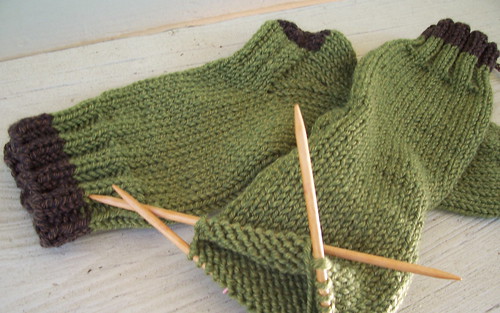
Knitting the foot is the easiest part. You just knit round and round in st st until your the sock measures about 7-1/2 (8-1/2) inches long (or about 2 inches less than the desired overall length of the foot), measuring from the back of the heel.
sockprogress

toe
Rnd 1: Knit to last 3 st on needle 1, K2tog, K 1. On needle 2, K1, SSK, K to last 3 st, K2tog, K1. On needle 3, K1, SSK, K to end. 4 st dec.
Rnd 2: Knit.

Rep these last two rows, dec 4 st every other row in this manner until 18 (24) st rem [that's half of the total - right?].

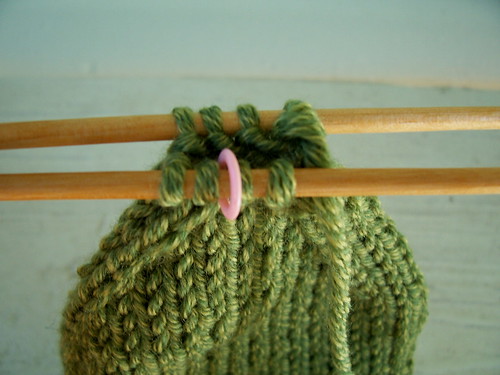
Now dec every rnd until only 8 st rem. We're ending with 8 st no matter how many we started with - sorry to break up the halves & quarters party. Arrange the st so that you have 4 on each needle - the first and last two st on needle 1, and the middle 4 st on needle 2.
100_1731

grafting the toe with kitchener stitch
Cut off your yarn so that you have about a 6-inch tail.
Using a tapestry needle, first thread the yarn through the front stitch purl-wise, leaving this stitch on the needle.
Next, thread the yarn through the back stitch knit-wise, leaving this stitch on the needle.

1. Thread the yarn through the front stitch knit-wise and slip this stitch off the needle. Thread the yarn through the next front stitch purl-wise, leaving this stitch on the needle.

2. Thread the yarn throug h the back stitch purl-wise and slip this stitch off the needle. Thread the yarn through the next back stitch knit-wise, leaving this stitch on the needle.

Repeat numbers 1 and 2 until you have grafted all the stitches together. (Tip: if you have any copies of Interweave Knits magazine lying around your house, go look up Kitchener Stitch in the glossary at the back - they have an excellent illustration).

Thread the yarn inside the sock and tie a knot discreetly inside, then weave in the loose end. Weave in all your other loose ends.

Now make another one!

PS: I knitted these socks using just a little bit of contrast color for fun. You could leave it out entirely, make more stripes in the leg, or make the toe with the contrast color as well. If you decide not to use the CC, you can forego that extra ball of yarn altogether. Just take note that for the woman's sock, if you make it any longer than I did in the leg or the foot, you're going to need another ball of the MC yarn, because 2 balls is just barely enough for this project.

important notice: This is a free pattern and you are welcome to use it for all the non-commercial purposes you like. However, you may not reproduce this pattern to sell, and you may not sell what you make with it. You may donate what you make with it to charity, and you may use it for charity fundraisers only if 100% of the proceeds are donated to the charity (and by charity I don't mean your kid's college fund). Thanks for understanding!
Wednesday, October 04, 2006

numbers < death!


You have probably head the rumors already. Test results are in, and I did just fine on a math test this week. In fact - and I can hardly believe it myself - I got a 100. On a math test. All math. That's all it was. Using the proper formulas to solve equations. Did you see that flock of pigs flying south for the winter? Pretty amazing, huh?

Despite all the whining, this biostatistics class is not going to kill me. It may be challenging, it may suck up a lot of time that I would otherwise spend knitting, going to yoga or hanging out with friends, it may require me to use the function keys on my calculator (shudder), but it is utterly do-able. I feel a little taller this week, like I have slain (slew?) a demon that has haunted me since middle school. Take that, equations!

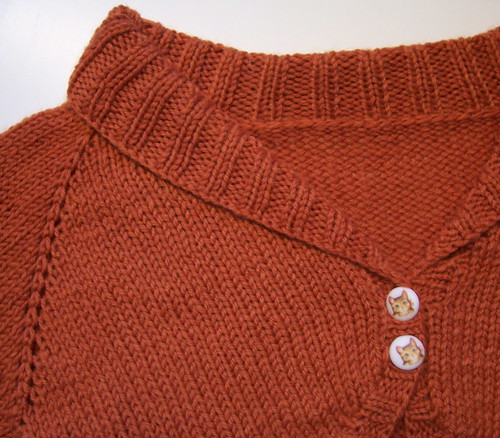
In other news, the baby bolero (pictured above) is headed off to its rightful owner today. I am not happy at all with the weird bunching and imbalance that blocking didn't quite manage to cure (though it improved noticeably). But it is her first birthday, so this is what she's getting. She's too little to care whether it bunches anyway.

Also, mad props to Yarnmarket, who besides having the cutest little lamb as their logo, now have an Eco-Friendly Fibers section on their website. I've never even heard of half this stuff - I wish they'd send me samples to review on my blog (hint, hint - Yarnmarket are you listening?).

Look for a free pattern this Friday...

Sunday, October 01, 2006

rocktober


Will it rock? Only time will tell, I suppose, but so far I think this month is looking good, at least based on this weekend. The weather is gorgeous, our house is clean and I'm more or less caught up on biostats homework. The pantry is stocked, the yarn bin is... well, overstocked, and Jackie seems to be over her bout of kitty bladder infection (Yuck. I'm really glad that's over).

This weekend felt like a reprieve. Instead of going out of town as had originally been planned, we got to stay home and do nothing (my favorite activity). And since our plans were cancelled at the very last minute, nobody even knew we were here. The phone didn't ring once, we had no plans and we made none. Aaah! This is the life!

My butt is sore from Saturday morning, because we went down to the farm to help with the sweet potato harvest. Y'all, digging taters is hard work, in case you didn't know. If you have a choice between digging taters and picking something like beans or tomatoes, take the picking job. You'll thank me later. Despite the sore butt, I felt productive and got some fresh air and exercise, so that pretty much kept me from feeling any guilt about spending the rest of the weekend slacking off.

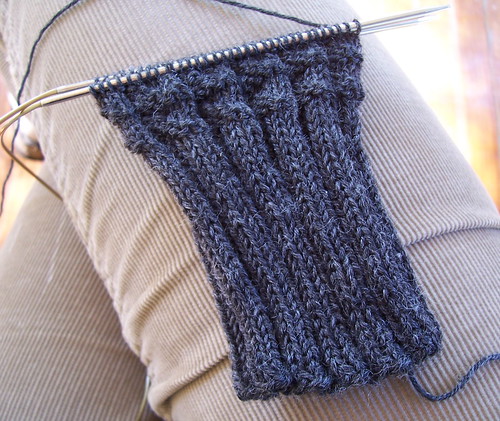
As you can see from the above photo, I have cast on in celebration of Socktoberfest. This is my official Socktoberfest project, the Gentleman's Shooting Stockings from Knitting Vintage Socks. These are for HWWLLB so I'm doing them in charcoal gray, but now that I've gotten going I wish I'd picked more exciting colors. On the other hand, this is lovely Swiss sock yarn sent to me ages ago by my SP, Rebecca, and I'm glad to finally be using it.

Happy October, y'all. I'm about to go chow down on a delicious piece of apple pie, thanks to chef HWWLLB, who can't stop himself from baking now that there's a little snap in the air.

Friday, September 29, 2006

color change


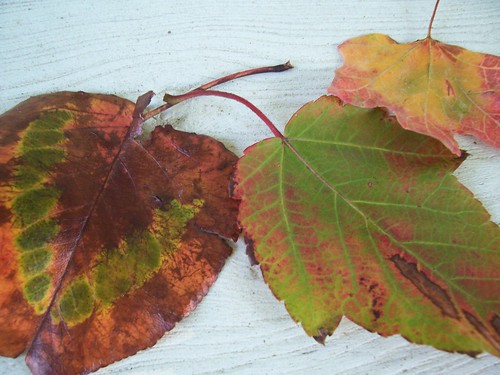
Fall is my favorite season. I love walking to work on crisp mornings and stopping to marvel over beautiful leaves like these. Color! Bright, earthy fall colors are the best ones, to me.

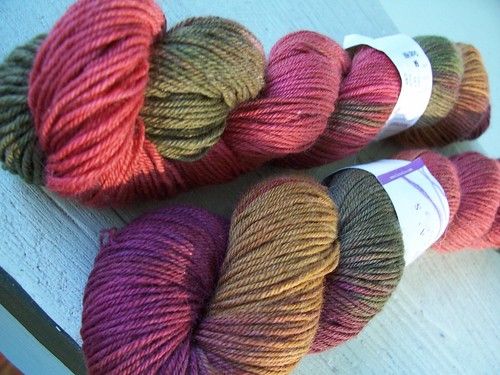
The snap in the air gets me itching to knit, too. The other day I stopped in at the LYS and the Haphazard Knitter nefariously pointed me to their new stock of Lorna's Laces... just what I needed. A big seductive pile of hand-dyed yarn. But so beautiful! Look at this colorway in the Shepherd sock yarn that I somehow couldn't stop myself from buying (this yarn has magical powers to make debit cards begin vibrating and leap from unsuspecting pockets):

lorna_goldenhill
just like the leaves i keep stopping to pick up

Then those wicked women at kpixie sent out their little email teaser yesterday. Brushed Suri! Oh bliss! Oh yum! I know I said I was only going to knit socks as Xmas presents, but wouldn't you swoon for a floaty scarf made from Brushed Suri? My mom would, I am sure of it. And a scarf is even faster than a pair of socks, right? That's why two skeins of this yarn are now on their way to my mailbox. Because I am so practical. And because of the possessed vibrating debit card.

Over the weekend, while I was chugging away on evil statistics homework, my mailbox was brightened by the arrival of this:

mailprizes

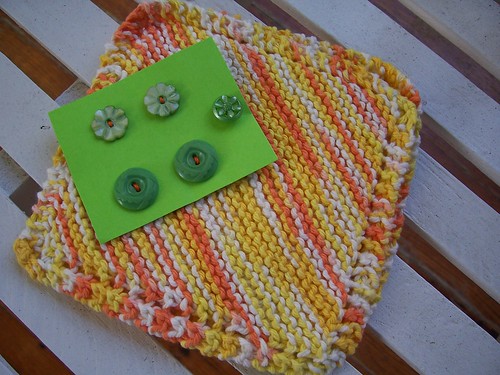
A package from Ms. Piry! She sent me the happy dishcloths and the woooonderful green vintage buttons in thanks for the buttons I sent her a few weeks back. What a delightful package, and I can't wait to use these buttons on something I knit for myself.

The good news is, it's not all-statistics-all-the-time at my house anymore. I have been spending a little time on the couch (and in the car) with the needles, and a quick pair of winter socks is almost done. I'll leave you with the progress pic and good wishes for crisp fall mornings and bright new colors.

sockprogress

Monday, September 25, 2006

the big and the small


Today I ran into an old friend at the coffee shop. She is in medical school and trying to figure out what to do with her practice and her life. We talked about what is important to us, and what we hope to achieve in our lives.

Isn't it funny how school and work and just life can sometimes get in the way of understanding what's really important? All the hustle and bustle, the incredible strain of keeping all the details organized, make the smallest things loom huge in their perceived importance, while the real goals practically disappear on the horizon. It is a rotten trick of perception.

I tend to be a pretty balanced person. Generally speaking, while I have a lot of stuff going on, I still leave the office at a respectable time most days, limit how much I work on the evenings and weekends, and make time to care for myself and relax with loved ones.

But I don't think that I make enough time just for reflection. Where have I been? Where am I going? What does it mean? How often do I actually relax and separate long enough from all the activity, so that the trick of perception dwindles and things appear as they really are?

100_1480

We are supposed to learn from our mistakes. I think I spend more time worrying about not making the next one.

Another friend of mine is about to go on a long trip. My hope for her is that while she is traveling in all these places she's never been (and may never go again), she gains the perspective she has been craving on her own life. I hope that all the little obstacles and worries appear scattered like leaves on the ground, and she can see what is really important, her values and her hopes for herself, infinitely larger in the landscape in comparison.

100_1503

Is there a way to gain this perspective all the time? And can you let go of worrying about little things, relatively meaningless things, without losing your attention to small things?

I think small things are different from little things. Little things are worries, anxieties, hang-ups, compulsions, wants and other things that make you unhappy, dissatisfied, and make you feel like less of a person than you want to be. Small things, on the other hand, are meaningful, just small. Beautiful things are often very small, but they can bring deep joy.

I aspire very much to letting go, completely and forever, of all the little things. I am not ready yet, but I hope to be soon. I am a little afraid of losing the small things in the bargain, though.

surfcity206

Friday, September 22, 2006

free pattern friday: baby om


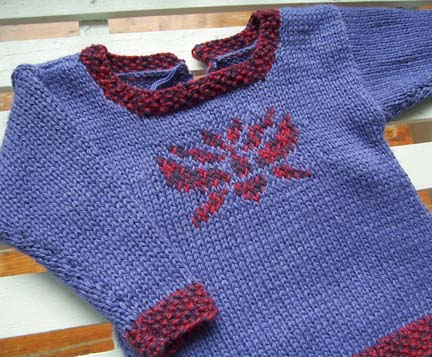
This is a versatile, colorful sweater with a simple intarsia motif. I chose a lotus, both because prenatal yoga was important to the sweater's recipient, and because the theme seemed to resonate with the strong colors I had in mind. Peaceful, calming symbols just can't hurt when you have a new baby in the house.

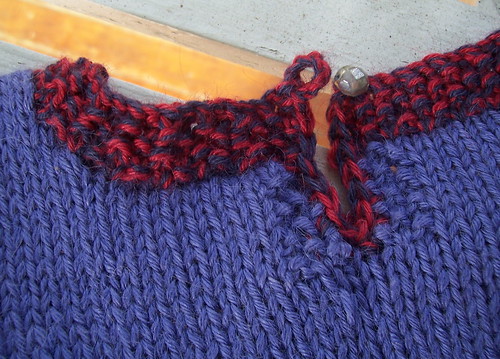
I knit this using two strands held together of Peruvian Baby Silk, a fingering-weight yarn made of 80% baby alpaca and 20% silk. The result is a luxuriously soft fabric with a loose drape, but you could subsititute almost any DK-weight wool or acrylic-blend yarn for this little pullover (you will need about 500 yards total). Instead of a button for the back closure, I used a small bead, but you can choose whatever you like, including velcro if you prefer.

materials
  • 6 balls of Elann.com Peruvian Baby Silk in color #1740 (Gentle Violet). 25 g; 109 yd each. Knit doubled (MC). Wind two balls together to form one doubled ball of yarn (three times).
  • 1 ball of Peruvian Baby Silk in color #1575 (Mulled Grape); and 1 ball of Peruvian Baby Silk in color #2020 (Claret). 25 g; 109 yd each. Wind these two balls together to form one doubled ball of yarn.
  • US size 6 and size 5 circular needles
  • US size E crochet hook
  • one 3/8 inch button or bead
gauge: 5 st/inch on size 6 needles

size: 0-6 mos (6-12 mos)

measurements:
chest circumference: 21 (24) inches
back length: 11 (13) inches
sleeve length: 7 (8.5) inches

back
CO 52 (60) st in CC using smaller needles. K 7 rows in seed stitch (K1 P1 every row).
Row 8: Change to larger needles and MC yarn. Knit this row and all following rows in stockinette stitch (K on RS, P on WS). Continue knitting until the piece measures 8.5 (10.5) inches from CO edge.

neck opening
Next RS row: K 23 (27) in st st, K 3 in seed st, turn work leaving remaining st on a stitch holder.
WS: K3 in seed st, K to end in stockinette.
RS: K to last 3 st, K3 in seed st. Repeat last 2 rows 3 times more, ending on WS row.
Next RS row: K to last 9 st, slip them onto a st holder, turn work.
Next WS row: P2 tog, P to end.
Next RS row: K to last 2 st, K2 tog. Continue in st st, dec 1 st at neck edge on every row until 14 st rem. Work without shaping until piece measures 11 (13) inches from CO edge. Leave rem st on holder.

With RS facing, rejoin yarn and finish the other side to match.

knit the front
CO 52 (60) st in CC using size 5 needles. K 7 rows in seed stitch (K1 P1 every row).
Row 8: Change to larger needles and MC yarn. Knit this row and all following rows in stockinette stitch (K on RS, P on WS). Continue knitting until the piece measures 5.5 (7.5) inches from CO edge.

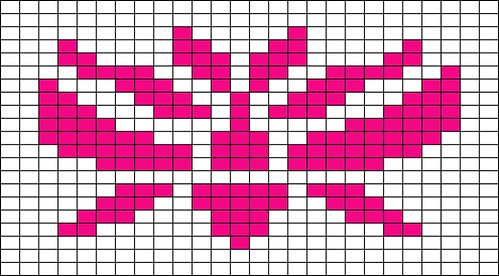
Next RS row: work intarsia pattern, centering motif at the chest. (Intarsia pattern is 23 st wide and 17 rows high). Cont knitting until piece measure 9 (11) in from CO edge.

lotus_graph

Next RS row: K 16 (20) st, BO 20, K to end.
WS: K to end (leave rem st on the opposite side on a st holder).
RS: K 2 tog, K to end.
WS: P to last 2 st, P2 tog.
Repeat the last two rows until 14 st rem on needle. Cont without shaping until piece measures the same as the back. Leave shoulder st on a holder.
Complete the other side in the same manner.

sleeves (make two)
Using smaller needles, CO 25 (30)st in CC. K in seed st for 7 rows. Change to larger needles and MC.
K 4 rows in st st.
Next RS row: Kfb of 1st and last st in this row. Continue this double increase on every other RS row until there are 47 (68) st on the needle. Cont in st st without shaping until sleeve measures 7 (8 1/2) inches.

collar
Use the three-needle bind-off method to join the two shoulder seams.
Using smaller needles and CC, beginning at the back divide and working around towards the front, pick up all the collar st. As you go, pick up all BO st , and 3 out of 4 selvedge st around the sides of the neckline. If you still have live st on a st holder, pick up all of them. Cont around to the other side of the back divide so that you have picked up all the collar st. Turn work and knit 4 rows in seed st. Next row: BO all st.

finishing
You will use the crochet hook to "finish" the inside edges of the back divide in the contrast color. Using the crochet hook and CC yarn, SC 8 st down inside of back neck opening and 8 st up the opposite side. Chain 10 st for a button loop, sew loop down.

om_closure

Sew sleeves into sweater. Sew up side seams and sleeve seams. Weave in loose ends. Sew button into place.

post script
If you have any problems with this pattern, please email me (f [dot] pea [at] airpost [dot] net). This is a very simple sweater, but I only took sketchy notes while I was knitting, so the pattern may be less thorough than I realize.

important notice: This is a free pattern and you are welcome to use it for all the non-commercial purposes you like. However, you may not reproduce this pattern to sell, and you may not sell what you make with it. You may donate what you make with it to charity, and you may use it for charity fundraisers only if 100% of the proceeds are donated to the charity (and by charity I don't mean your kid's college fund). Thanks for understanding!